
Atoll One
- Home
- Atoll One
Atoll One
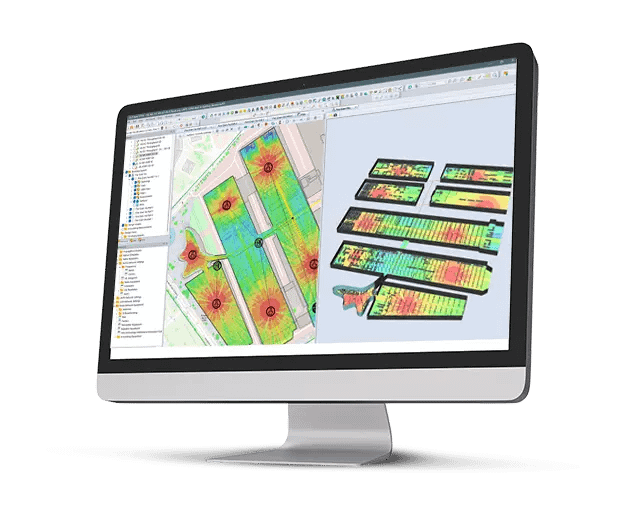
Atoll One is a dedicated version of Atoll, specifically designed for the planning and optimisation of small to medium-sized outdoor and indoor Private Mobile Networks.
Atoll One includes all the essential features of Atoll needed to design, plan, and deploy 4G LTE, 5G and WiFi wireless private networks in any environment; it delivers the same level of performance, accuracy, and reliability that has made Atoll the industry-leading tool for radio planning and optimisation — all within a single, easy-to-install, easy-to-learn, and easy-to-use package.
Atoll One
Designing Private Mobile Networks with Confidence
Atoll One provides users with all the functionalities required to plan and optimise private LTE, 5G and Wi-Fi networks, in a package that can include GIS data required for any type of project. Atoll One can be installed in minutes and is the ideal solution for both Private Mobile operators and engineering working on a project basis.

Integrated In-Building and Outdoor Modelling
Atoll One allows the design of the outdoor and indoor components of a private network within a common software environment, with full modelling of the interactions between both parts of the network. The Aster propagation model is built into Atoll One to ensure a high level of accuracy.
Atoll One Features
Supported Technologies
- 4G, 5G, Wi-Fi, and Microwave Links
Built-in Propagation Models
- Aster model for outdoor networks
- Multi-wall model for indoor environments
- Calibration using real-world measurements for maximum accuracy
Building Modelling
- Automatic import of floor plans in industry-standard formats
- Detailed 3D modelling of buildings, floors, and structural components (walls, surfaces, openings, pillars, tunnels, etc.)
Distributed Antenna Systems Modelling
- Modelling of active, passive, and hybrid DAS networks: sources, antennas, radiating cables, amplifiers, master/expansion/remote units, etc.
- Integrated in-building equipment catalogue
Network Predictions
- Seamless multi-RAT predictions combining indoor and outdoor coverage, with the ability to study cross-environment interactions and interference
Network Validation
- Import, display, and analysis of drive and walk test data
Using Atoll One to design a private mobile network for...
In this use case, a car manufacturing facility operates its own private 4G LTE network to support a wide range of industrial applications, including automated production lines, connected tools, quality control systems, and staff communications. A reliable and high-performance wireless network is required to ensure smooth, uninterrupted operations across the factory floor and in adjacent buildings. Atoll One enhances the network planning process by allowing users to import detailed architectural data from AutoCAD DWG or BIM IFC files. This enables accurate modelling of the factory’s physical environment, including walls, floors, ceilings, pillars, and other structural elements.

Each component can be assigned specific materials and electromagnetic properties, which are used to simulate radio wave propagation with a high degree of realism. This detailed in-building modelling helps engineers identify potential coverage gaps, interference zones, or areas of poor signal penetration, and optimally place indoor antennas or small cells to ensure full coverage across the production site.
In this scenario, an airport operates a private LTE network to ensure seamless communication between ground staff, maintenance crews, and aircraft systems while planes are on the tarmac. Reliable connectivity is critical for real-time data exchange, logistics coordination, and ground operations efficiency.
While an outdoor LTE network has been deployed near the runways and taxiways to support apron and airside coverage, it does not provide adequate signal penetration into the terminal buildings, hangars, and other indoor facilities.

To address this, an in-building Distributed Antenna System (DAS) has been installed within the airport infrastructure.Atoll One enables a hybrid modelling approach that combines both outdoor and indoor environments into a unified simulation. This allows to consider the full complexity of the airport layout, including the materials and structures of each building, when predicting signal propagation. As a result, planners can accurately assess indoor and outdoor coverage, optimise antenna placement, and ensure consistent network performance throughout the entire airport complex.
This use case is one of the most complex deployment scenarios: a large mining site that includes a mix of outdoor terrain, in-building infrastructure, underground tunnels, and remote locations requiring backhaul connectivity. Initially, an outdoor LTE network provided strong coverage across the open site. However, as mining progressed and a deep mine pit was excavated, coverage challenges emerged due to signal blockage and terrain variation.
To maintain consistent connectivity, multiple small base stations were deployed inside the pit, ensuring localised coverage. Additionally, a network of radiating cables and active DAS was installed within the underground tunnels to support staff safety systems, autonomous vehicles, and operational monitoring. Because of the site’s hilly topography and the remote location of many installations, microwave links were used to connect base stations to the central base camp.

Atoll One’s advanced modelling capabilities allow for the accurate simulation of signal propagation in these complex environments, including variable terrain, subterranean passages, and multi-hop microwave backhaul links. This holistic view ensures that the entire network—from open sky to underground—operates efficiently and reliably under all conditions.
Ready to explore ATOLL One?
Contact enquiries@teleres.com.au for more information about products.